
I get some version of this question almost every week. Usually it's not phrased quite this directly. It comes disguised as "how long does the course take" or "will companies actually hire someone with no tech background," but underneath it, the real question is always the same: have I already missed my window?
The short answer
No — and not in a "believe in yourself" way. In a boring, practical, math way.
Think about it like renovating a house versus building a new one. If you're 22 with no career yet, you're building from an empty plot: total freedom, but you're also starting from zero on everything: no savings, no network, no sense of how offices actually work. If you're 30 or 35 with eight or ten years of work experience, you already have a house standing. You're not starting over. You're renovating one wing of it. And you get to keep everything else: the discipline of holding a job, the ability to sit in a meeting and not panic, the network of people who already trust your work ethic, even if it was in a different field.
That's not a consolation prize. In hiring terms, it's often a real advantage. A 32-year-old career switcher who used to manage a small team in operations, or handled client escalations in sales, or ran a mechanical QA process, walks into a data analyst interview with something most 22-year-old fresh graduates simply don't have yet: proof they can be trusted with a real job.
What actually determines whether you make it
Not your age. People fixate on age because it's an easy number to blame. What decides this is more ordinary than that: how much time you really put in over a real stretch of months, whether you build something you can talk through in an interview instead of just watching videos, and whether your current job gives you a genuine story worth telling. None of that has anything to do with when you were born.
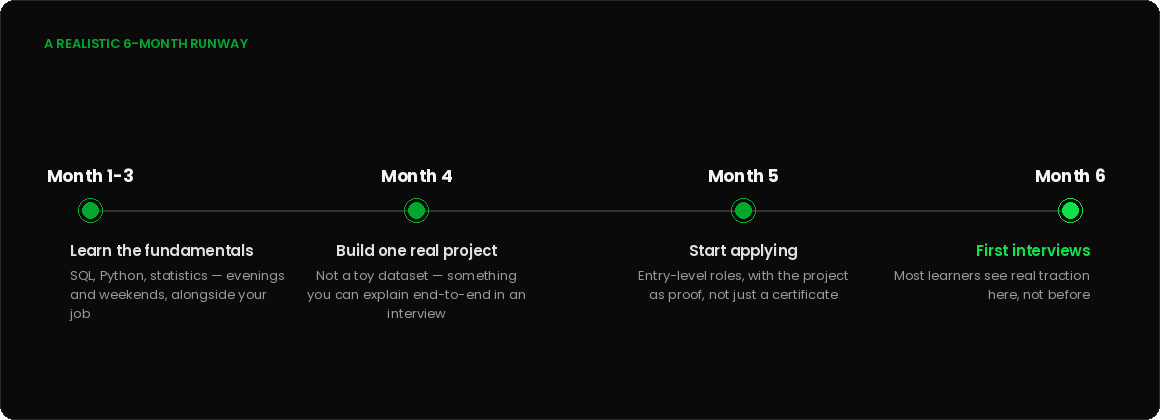
Thirteen weeks feels slow when you're impatient to change your life. It feels fast when you remember it's under three months out of a working career that's probably going to last another 25-30 years. The math is more forgiving than the anxiety makes it feel.
What this looks like
Most real career switches don't look like a highlight reel. They look like a slow, slightly boring stretch of Tuesday evenings spent practicing SQL instead of watching TV.
What I can point to are real outcomes: learners from our own programmes now working as analysts at TCS, Broadridge, Revature, and NielsenIQ, several without a computer science background at all. What they had in common wasn't age or a particular degree. It was that they treated the thirteen weeks as a real commitment, not a side hobby they'd get to eventually.
The real downside
Switching at 30 is harder in one specific way: you likely have real financial responsibilities — rent, a family, a loan — that a 22-year-old typically doesn't. That means you probably can't afford to quit your current job on day one and "figure it out." The realistic path is almost always doing this alongside your current job for the first few months, not instead of it. It's slower that way. It's also far less risky, and it's how most people we've worked with have done it.
Thirteen ordinary, unremarkable weeks. That's really the whole ask for the course itself. The job search after is its own, less predictable stretch.
Before you commit, ask yourself this
Can you give this 8-10 hours a week for thirteen weeks, without it becoming your fifth attempt at "finally learning to code"? Do you have one real reason you want this — better pay, steadier demand, plain curiosity — rather than just "everyone says AI is the future"? And are you willing to build something real, not just collect a certificate?
If your answer to all three is yes, age was never really the obstacle. If it's no to any of them, that's worth sitting with too. A career switch started half-heartedly usually costs more time than not starting at all.
Quick answers
Is 30 too old to become a data analyst?
No. What matters is the time you put in, whether you build something real instead of just watching videos, and whether your work history gives you a genuine story for interviews. Age doesn't come into any of that.
How long does it realistically take to switch careers into data analytics?
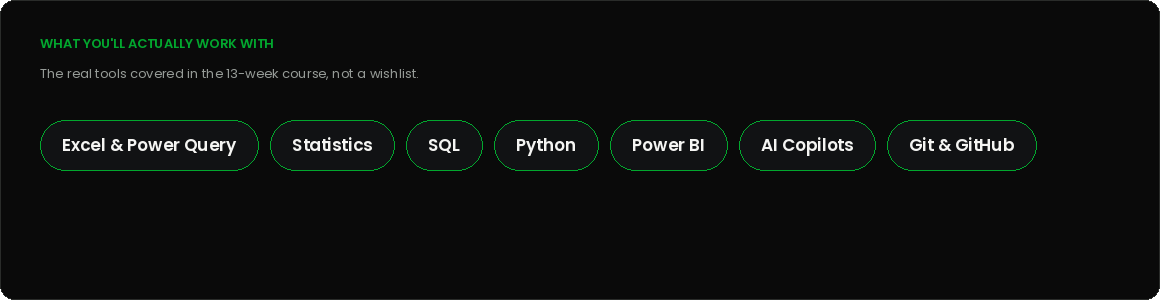
The course itself runs 13 weeks: Excel and Power Query, statistics, SQL, Python, Power BI, and AI-assisted analytics, ending in a real capstone project. Job hunting after that is separate. How long it takes depends on your market and effort — we can't promise a number for that part.
Do I need a coding or computer science background to switch into data analytics?
No. Many successful career switchers come from non-technical backgrounds like operations, sales, or mechanical roles. What matters more is a genuine reason for the switch and a willingness to build a real, explainable project rather than just collecting certificates.